How to Resolve Excessive Ripple in LED Mirror Drivers
Excessive voltage and current ripple remains one of the most common mass production quality pain points for smart LED mirrors and vanity lights. As a professional lighting manufacturer, we’ve observed that out-of-spec driver ripple rarely occurs in single units. It frequently causes batch reworks, customer returns, project delivery delays and certification failures, resulting in unnecessary production losses and high after-sales costs.
Compared with standard LED luminaires, LED mirrors have unique structural and operational characteristics that make them more susceptible to ripple issues during mass production. Their compact internal structure, simultaneous operation of LED lighting and defogging modules, frequent low-brightness dimming, and ultra-compact PCB layout all contribute to severe ripple fluctuations. Based on Divas’ in-house batch testing and QA sampling, most non-compliant mirror products exhibit ripple levels above 10%, failing standard commercial and hospitality lighting requirements.
Batch Quality Risks Caused by High Ripple (Divas On-Site Summary)
Through strict incoming material inspection, long-term aging tests and finished product sampling, we’ve summarized three major batch quality risks caused by excessive ripple:
✅ Batch flicker and camera banding issues High-frequency ripple causes subtle low-level flicker that is invisible to the naked eye but prominent in mobile phone and camera recordings. This results in failed anti-flicker tests and large-scale product rejection, particularly for hotel, bathroom and residential smart mirror projects.
✅ Unstable aging performance and inconsistent batch quality Continuous ripple current impact causes uneven LED luminous efficiency and accelerated light decay across production batches. It also forces electrolytic capacitors to operate under unstable electrical conditions, shortening the overall service life of finished mirrors and increasing long-term after-sales failure rates.
✅ Higher EMC failure rate and smart module malfunctions Uncontrolled ripple generates persistent electromagnetic interference, triggering intermittent errors in touch dimming, Bluetooth connectivity and defogging functions on smart mirrors. It is also a leading cause of EMC certification failures for bulk orders.
Root Cause Analysis Based on Mass Production Defects
Combining years of incoming QC data, SMT production experience, finished product aging results and customer feedback, we’ve pinpointed the root causes of recurring high ripple in LED mirror driver batches:
1. Low-grade drivers and inconsistent component tolerance Cost-effective generic drivers often adopt simplified filter circuits and substandard low-ESR capacitors. Loose component tolerance ranges lead to inconsistent ripple performance across mass-produced units.
2. Constrained and non-standard PCB layout The ultra-slim design of LED mirrors limits internal space, resulting in highly dense PCB routing. Irregular high-current trace arrangement and improper ground partitioning induce parasitic inductance and capacitance, which greatly amplify output ripple during mass production.
3. Driver and LED load mismatch Universal drivers rarely match the actual impedance of different LED string configurations for various mirror sizes. Operation under unbalanced low-load or partial overload conditions during long-term mass aging triggers severe current ripple jitter.
4. Defogging module mutual interference Smart LED mirrors integrate both lighting and heating functions. Frequent defogger switching generates instantaneous power surges and bus voltage fluctuations, creating periodic ripple spikes — a unique and prevalent quality pain point for vanity mirror lighting products.
Divas-Level Batch Optimization & Rectification Solutions
To fundamentally resolve batch ripple defects, our engineering and production teams have developed stable, mass-producible optimization standards exclusively tailored for LED mirror products:
1.Standardized driver incoming QC We enforce clear Divas ripple benchmarks: ≤5% for premium mirror models and ≤10% for standard products. Every batch of drivers undergoes strict ripple sampling inspection before mass production. Custom low-ripple LC filter circuits are exclusively adopted for mirror light systems to ensure consistent batch performance.
2. Unified PCB layout production standards We implement standardized SMT routing specifications for all mirror light PCBs: minimizing high-current loops, strictly separating analog and power grounds, and placing filter components close to output terminals. This eliminates batch-to-batch ripple deviations caused by irregular layouts and manual operational differences.
3. Precise load-driver matching We eliminate the use of one-size-fits-all universal drivers. Instead, we configure drivers with reasonable power margins based on mirror dimensions, LED bead quantity and defogger power. This stabilizes current output across the full dimming range and suppresses ripple during dynamic load changes.
4.Anti-interference design for dual-module operation Independent surge suppression and filter circuits are integrated into defogging modules during mass production. This effectively isolates interference between heating and lighting circuits, maintaining stable ripple performance after long-term aging and simultaneous dual-function operation.
5. Full-condition compliance testing All finished products are tested in accordance with IEC 61347-2-13 and IEC 62384 standards. We simulate extreme working scenarios, including low-brightness dimming and continuous defogger operation, to ensure all batch products meet global commercial and hospitality lighting certification criteria.
Our factory Experience Summary
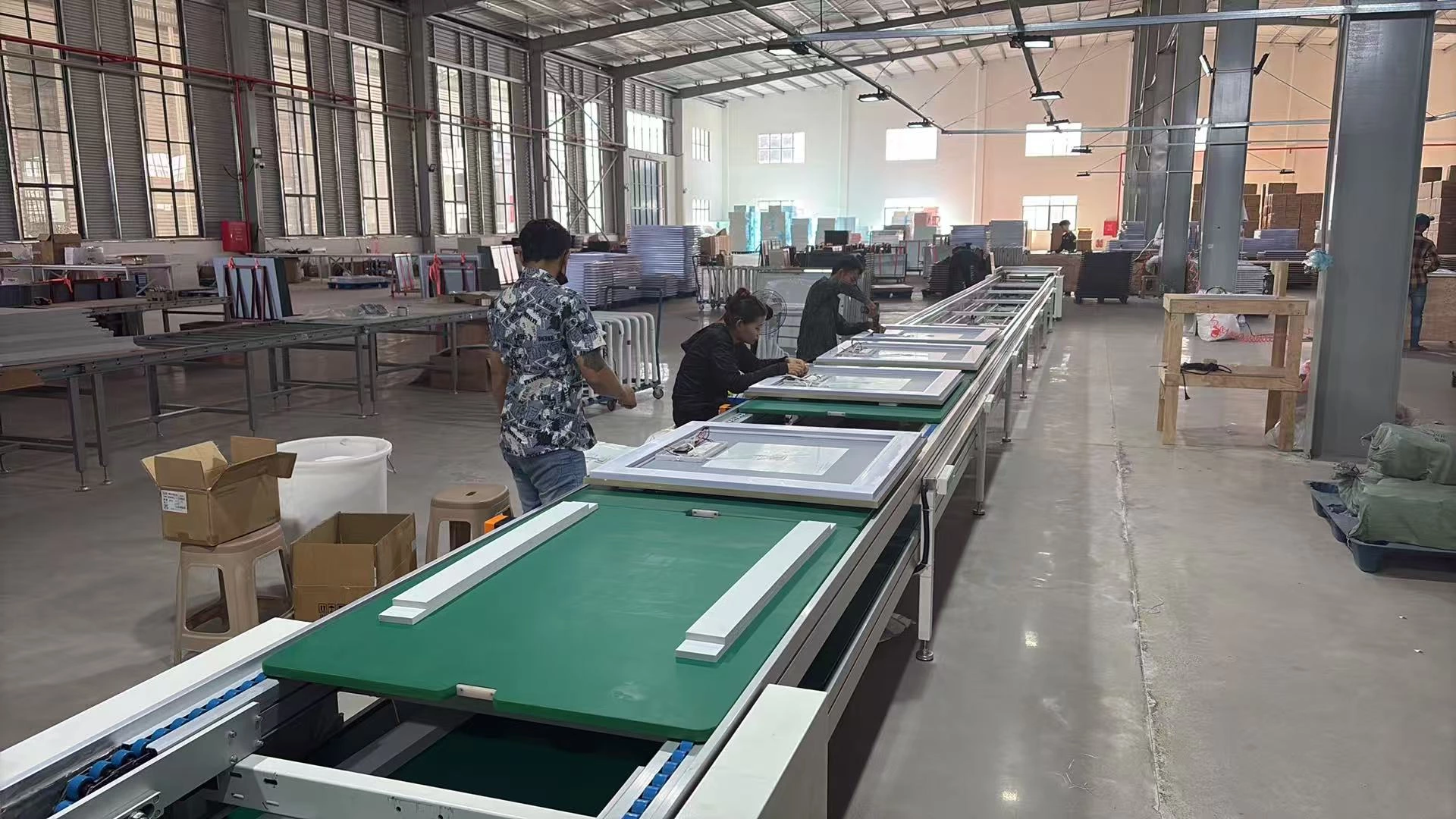
LED mirror ripple issues are systematic quality challenges rather than isolated product faults, covering component selection, structural design, production craftsmanship and batch testing. Standardized production workflows and rigorous quality control are essential to eliminating batch defects, improving product stability, and building competitive advantages in high-end engineering and overseas markets.
As a professional LED mirror manufacturer, we continuously optimize production technologies and quality standards to deliver stable, flicker-free, highly reliable smart mirror products. We sincerely welcome global buyers, engineers and industry partners for technical exchanges and business cooperation!