What’s the Standard Mirror Size Rule?
How To Choose A Wall Mirror Size for Your Space?
Dec.10, 2025 By Ivy Lv
Let’s be honest. Picking a mirror feels like it should be simple. You find one you like, you hang it up, done. But then… something feels off. The room doesn’t look better; it just looks like there’s a random mirror stuck on the wall. Maybe it’s too small and gets lost. Maybe it’s so big it feels like it’s crowding you.
We’ve all been there. That nagging feeling is your eye telling you the scale is wrong. The good news? Getting it right isn’t about fancy design degrees. It’s about following a few practical, almost foolproof guidelines. This guide will walk you through, room by room, how to choose a mirror size that doesn’t just fit, but actually transforms your space.
Forget Complicated Math: The One “Golden Rule” You Actually Need
You’ll hear a lot about the “Golden Ratio” and complex calculations. Let’s simplify. The single most useful rule of thumb for a harmonious look is this:
Your mirror’s width should be roughly 2/3 (or 60-75%) of the width of the furniture it hangs above.
Hanging it over a 48-inch wide console table? Look for a mirror about 32 to 36 inches wide. Above a 60-inch vanity? Aim for a 40 to 45-inch wide mirror. This proportion creates balance. It lets the mirror be a starring feature without competing with the furniture. It leaves just enough “negative space” on the sides to feel intentional and calm.
But Here’s the Real Secret: This isn’t a rigid law. It’s your starting point. Sometimes you break it for a specific effect (more on that later). But if you’re unsure, this rule will never steer you wrong.
Room-by-Room Breakdown: Because a Bathroom Isn’t a Bedroom.
This is where things get practical. The “right” size changes dramatically based on what you do in the room.
The Bathroom Vanity Mirror: Your Morning MVP
This is the workhorse. It’s not just decorative; it’s functional. You’re shaving, applying skincare, putting on makeup. The size directly impacts your routine.
-
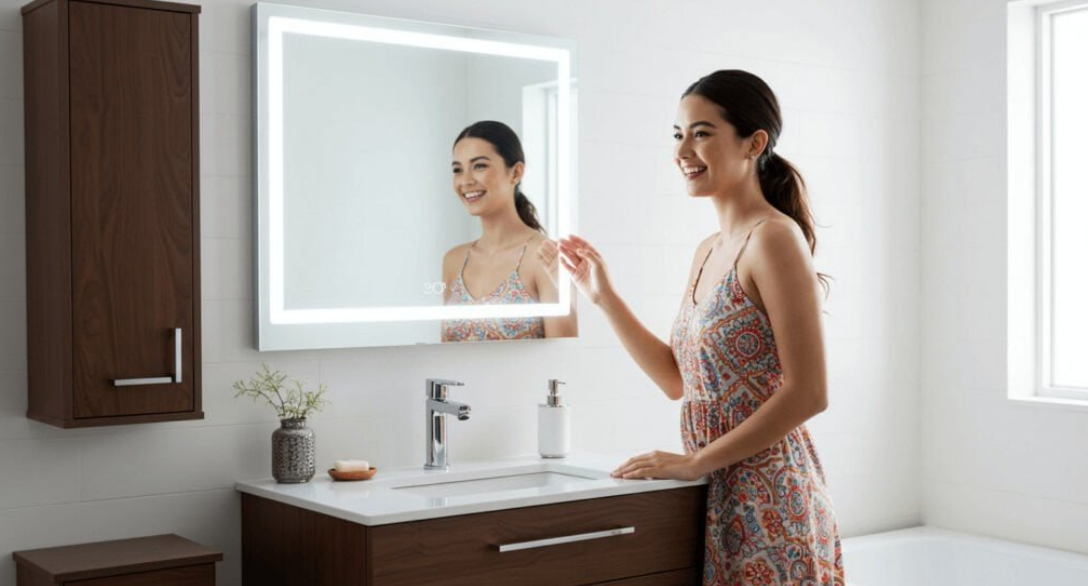
The Width Rule (Applied): As per our golden rule, your mirror should be 4-6 inches (10-15 cm) narrower than your vanity countertop. A mirror wider than the vanity looks top-heavy and awkward. For a standard 36-inch vanity, a 30-32 inch mirror is ideal.
-
The Height & Hanging Rule: The bottom edge of the mirror should sit about 4-10 inches (10-25 cm) above the backsplash or countertop. This prevents splashes and gives you space for canisters or trays. More importantly, it ensures the mirror’s reflection is centered for the average person’s eye level. If you’re tall, factor that in!
-
Double Vanity Dilemma: Got a 60-inch+ double vanity? You have two great options:
-
One Grand Mirror: A single, wide mirror (60-72 inches) creates a sleek, modern, unified look. It makes the space feel larger.
-
Two Separate Mirrors: Installing two individual mirrors (typically 24-30 inches each) is more traditional and allows for personalized lighting (like his-and-hers light settings). It can also be easier to install around existing plumbing or outlets.
-
-
Functional Considerations: LED Lighting & Defogging
Once the foundational size is determined, the functional features of your mirror become the next crucial decision point. Modern LED bathroom mirrors and anti-fog mirrors offer practical benefits that traditional mirrors lack, but it’s important to understand their characteristics before committing.
The primary advantage of an LED mirror lies in light quality. By integrating LED strips around the perimeter, it provides even, shadow-free diffused light directly onto your face from the front. This is a significant upgrade for tasks requiring color accuracy, such as applying makeup or shaving. Many models also offer adjustable color temperature (e.g., from a warm 3000K to a cool 6000K), allowing you to tailor the ambiance for different routines, like a relaxing bath versus precise grooming.
Defogging functionality typically relies on one of two technologies: embedding heating wires/films behind or within the glass, or applying a special hydrophobic coating to the mirror surface. The heating method offers a thorough and lasting solution, ensuring a clear view immediately after a shower, but it requires an electrical connection. The coating method is passive and requires no power, though its anti-fog effectiveness and durability may vary.
Key Planning Note: Opting for these smart features necessitates advance electrical planning. The ideal scenario is to have a dedicated power outlet installed behind the mirror's planned location during a renovation. For existing bathrooms, you'll need to consider how to discreetly route the power cord (typically from the back or side of the mirror) to the nearest outlet. Using paintable cord-concealment channels is a common and effective solution for achieving a clean, integrated look.
The Bedroom Mirror: From Functional to Fabulous
Bedrooms need versatility. You need to see your full outfit, but you might also want a dedicated spot for detailed grooming.
-
The Full-Length/Floor Mirror: If you’re leaning it against a wall or hanging it low, it needs to be tall enough to reflect a person from head to toe. Minimum width is usually 18-22 inches (45-55 cm), but 24-30 inches (60-75 cm) is more comfortable and functional. Place it where it gets good natural light if possible.
-
The Dresser or Vanity Mirror: This sits on a dresser or hangs above it. Use the 2/3 rule relative to the dresser width. But also consider its purpose.
-
For Decoration: A beautiful framed mirror that follows the size rule is perfect.
-
For Dressing & Makeup: This is another prime spot for a lighted vanity mirror. A width of 18-24 inches (45-60 cm) is common for tabletop models. A wall-mounted version above a dressing table can be wider, following the furniture-width rule. The focused, flawless light is invaluable.
-
The Living Spaces: The Art of the Statement
In the living room, dining room, or entryway, the mirror’s job is less about utility and more about drama, light, and illusion.
-
The Entryway Mirror: This is your welcome mat. It’s for a last-second check before heading out. A 24-36 inch (60-90 cm) wide mirror is usually perfect for most entryway consoles or walls. It’s functional without overwhelming a potentially tight space. A well-placed mirror here can also make a narrow hallway feel twice as wide.
-
The “Statement” Wall Mirror (Living/Dining Room): This is where you can break the rules on purpose. Want to make a huge impact? Choose an oversized mirror that’s almost as wide as the wall or the sofa it hangs above. A large mirror over a mantel or behind a sofa acts like a window, bouncing light deep into the room and making the space feel airy and grand. Think 48 inches to 60+ inches wide. Conversely, a gallery wall of small, eclectic mirrors can be a stunning, personal focal point.
-
The Dining Room Mirror: Often hung over a sideboard or buffet. Here, balance is key. A mirror that’s roughly the same width as the furniture (or slightly narrower) creates a dignified, anchored look. It reflects the room’s ambiance and can make dinner parties feel more lively.
The Nitty-Gritty: What Everyone Forgets to Ask.
Beyond the tape measure, here are the real-world questions that trip people up.
-
Does the Frame Count? YES. Absolutely, 100%.
When you’re applying the “2/3 of furniture width” rule, you are measuring the total exterior width of the mirror, frame included. The frame is part of the object’s visual weight. A chunky, ornate frame makes the mirror “feel” bigger in the space than a slim, frameless one of the same glass size. -
I Want a Lighted Wall Mirror. What’s the Catch?
The only “catch” is planning. Unlike a simple mirror you just hang on a hook, a powered mirror needs an electrical source.-
The Dream Scenario: During a renovation or new build, your electrician can run a wire inside the wall to an outlet placed directly behind where the mirror will hang. This gives you a completely clean, cordless look.
-
The Reality Solution (and it’s fine!): You can plug it into an existing outlet. The key is to have the outlet either above the vanity (so a short cord can be discreetly tucked behind the mirror) or strategically to the side. Using cord-hiding channels that you paint to match your wall can create a nearly seamless look. Think about this before you buy.
-
-
How High Do I Actually Hang It?
We covered this for vanities. For other walls, a classic interior design rule is to hang the center of the mirror at approximately eye level for an average person, around 57-65 inches (145-165 cm) from the floor. This feels natural in spaces where people are standing (like an entryway or behind a sofa). Always adjust for the furniture below it—the mirror should feel connected to the piece, not floating away
What Size Mirror is Too Big?
Specific dimensional limits depend on room size, but mirrors exceeding certain proportional thresholds create functional and aesthetic problems.
Mirrors larger than 48 inches wide in standard bathrooms or exceeding 75% of wall width in any room typically create oversizing issues. These dimensions overwhelm most residential spaces and furniture arrangements.
| Room Type | Maximum Recommended Width | Warning Signs |
| Small Bathroom (5×8 ft) | 30 inches | Extends beyond vanity edges |
| Standard Bathroom (8×10 ft) | 42 inches | Overwhelms wall space |
| Master Bathroom (10×12 ft) | 60 inches | Creates cramped feeling |
| Bedroom (10×12 ft) | 48 inches | Dominates furniture |
| Living Room (12×15 ft) | 54 inches | Overpowers seating area |
| Entryway (4×8 ft) | 36 inches | Blocks traffic flow |
Professional installations avoid mirrors that create these dimensional problems by following established proportional guidelines. Modern bathroom mirror selections should consider both current trends and timeless proportional principles. Backlit mirror installations require additional dimensional consideration due to their enhanced visual presence through illumination. Light up vanity mirror options often appear larger than their actual dimensions due to lighting effects. Room mirror ideas should always prioritize appropriate sizing over dramatic impact to ensure long-term satisfaction with the installation.
Your Mirror, Your Rules.
At the end of the day, these guidelines are here to give you confidence, not restrict you. If you love a huge, bold mirror that fills a wall, go for it. If a small, quirky round mirror speaks to you, make it work. Design is personal.
But if you want that feeling of “just right”—where the room feels balanced, bright, and intentionally put together—starting with these size principles is the way to go.
Final Advice: Start with Principles, End with Personality
Dimensions, proportions, and functionality form the rational foundation for choosing a mirror. They ensure harmony, utility, and safety within your space. Yet, all good rules ultimately serve your personal aesthetic and living needs.
If you are drawn to minimalism, a single, expansive mirror that nearly fills the wall can create a breathtaking statement, worthy of bending the “two-thirds” rule. If your heart leans towards eclectic charm, a gallery wall composed of smaller mirrors with intricate frames can hold more character than any dimension on a tape measure.
Therefore, view these guidelines as a reliable map—they guarantee you won’t get lost. But the most rewarding destination is always the mirror you choose courageously, guided by your own intuition and taste. It reflects not just the room, but your individuality and life within it.